
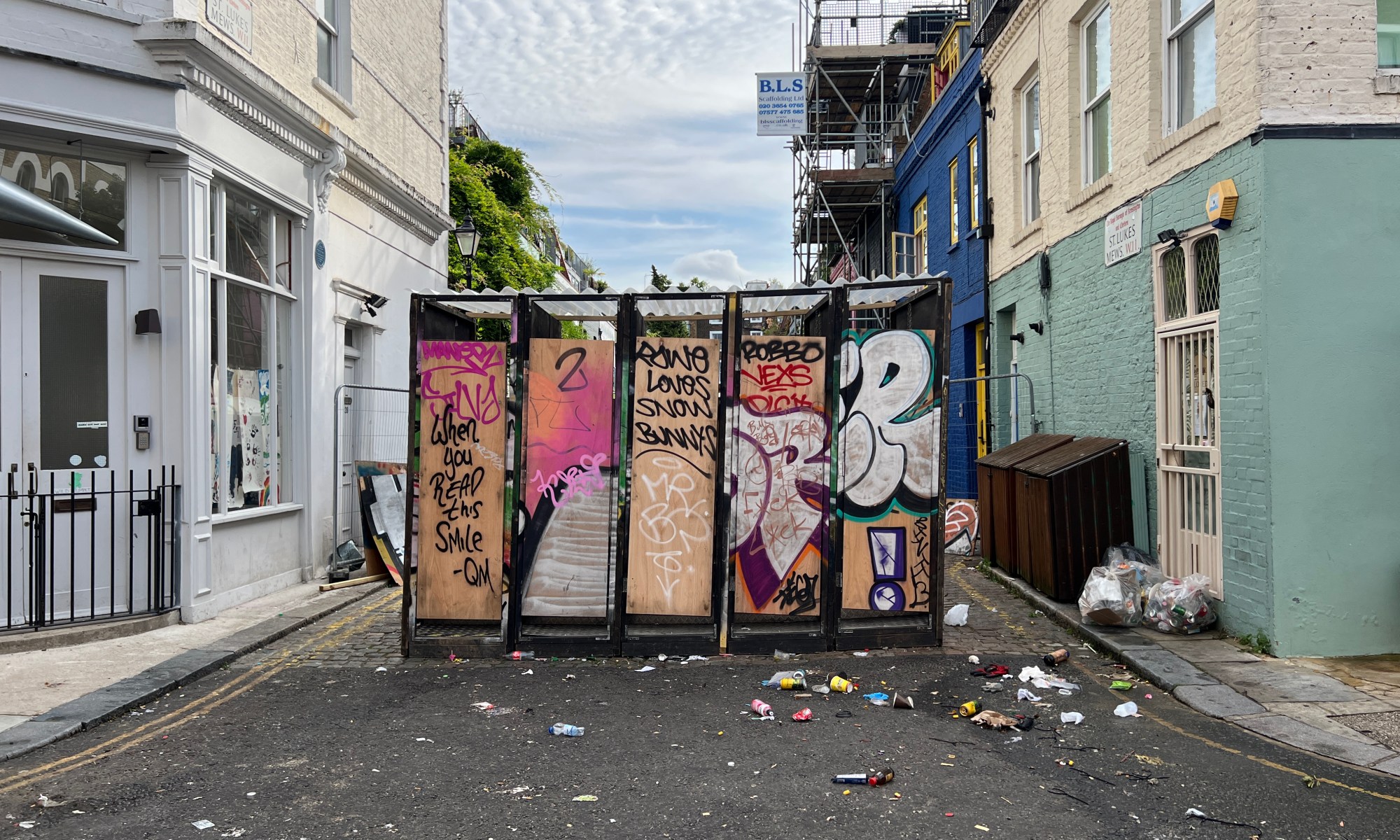
I am organising a session with Joanne Choueiri at the Royal Geographical Society annual conference, which will take place in London between 1-4 September 2026. The theme is “Geographies of concealment”, inspired by Joanne’s work on hoardings and our shared ongoing interest in temporary surfaces and spaces of hiding, masking, and covering in the city. Abstract and submission details below.
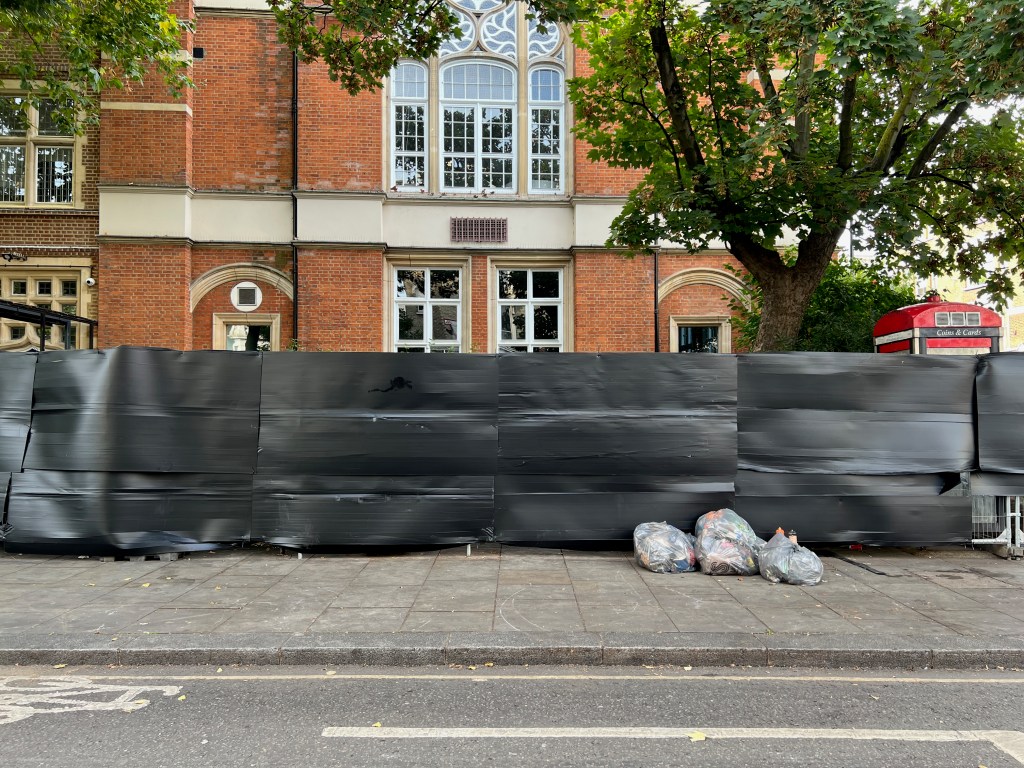
To conceal: not allow to be seen; hide.
This panel focuses on barriers as affective infrastructural tools (Bosworth, 2023; Henderson, 2008) that physically, visually, and behaviorally establish a temporary relation of masking, covering, or hiding space in the city. Through varying materialities, opacities, and scales, barriers impose a vertical limit that redirects movement, interrupts sightlines, and reshapes everyday spatial politics.
Temporary barriers have their own social functions (Brighenti 2019). Some are heavy and overtly securitised, such as Iraq’s concrete post-blast barriers (Murrani, 2016), Beirut’s Walls of Shame (Ghazal, 2024), or Turkey’s protest barricades (Ertür, 2016). Others are lighter, yet operate through visual forms of concealment and display, such as construction hoardings (Székely, 2019), disaster fencing, or scaffold nets. Across these forms, such structures generate what this panel terms a “geography of concealment”. They obscure political tensions, suspend access, and conceal future uncertainties while simultaneously regulating perception: determining what may be seen, remembered, and contested. These same barriers are also appropriated to create counter-visualities (Mirzoeff 2011), thereby subverting power dynamics in everyday urban spaces.
Across contexts shaped by crisis, securitisation, and speculative development (Jones, Robinson & Turner, 2012), temporary barriers increasingly operate as management devices of physical and visual concealment, or architectures of hiding (Abughannam et al., 2024). Concealment as such is not a neutral act but a political one that mediates power dynamics and contributes to the production of urban affects of fear, anticipation, and secrecy, as well as branding and aspirational images of urban development. This panel asks:
- In what ways do barriers function as tools for concealment, protection, or spatial control?
- How are barriers appropriated, contested, or reconfigured by residents, activists, or artists?
- How do hoardings and similar devices contribute to shaping urban imaginaries and projected futures?
- What is the meaning of “temporary” in these contexts — as a short-term condition, an ongoing state, or a strategic designation?
The panel invites contributions from researchers, artists, architects, and policymakers to examine the role of concealment in shaping urban visual cultures, atmospheres, and politics. We welcome contributions from disciplines such as urban and legal geography; cultural policy; architecture; sociology; urban planning and design; and communication, media, and semiotics studies.
Possible themes for 15-20min presentations include:
- Concealment as a form of spatial and visual governance
- Barricading, fencing, and boarding up as strategies of securitisation
- Materials of concealment: plywood, railing, fencing, netting, vinyl, and concrete
- Construction screens, building wraps, and scaffolding nets as media surfaces
- Protest, occupation, and the tactical reworking of barriers
- Hoardings, branding, and speculative urban futures
- Concealment and heritage destruction
Please email a title, 250-word abstract, and keywords, along with details of all authors, to Sabina Andron sabina.andron@unimelb.edu.au and Joanne Choueiri joannechoueiri@gmail.com by Friday, 20 February 2026. Selected abstracts will be notified within a week.
 SABINA ANDRON