
Urban surfaces, graffiti, and the right to the city
Routledge 2024, hardback and paperback
212 pages with 56 colour illustrations
Available from Amazon and Taylor & Francis.

Shortlisted for the Jane Jacobs Urban Communication Award 2024.
This landmark book focuses on urban surfaces, on exploring their authorship and management, and on their role in struggles for the right to the city.
Graffiti, pristine walls, advertising posters, and municipal signage all compete on city surfaces to establish and imprint their values on our environments. It is the first time that the surfacescapes of our cities are granted the entire attention of a book as material, visual, and legal territories. The book includes a critical history of graffiti and street art as contested surface discourses and argues for surfaces as sites of resistance against private property, neoliberal creativity, and the imposition of urban order. It also proposes a seven-point manual for a semiotics of urban surfaces, laying the ground for a new discipline: surface studies.
Page after page and layer after layer, surfaces become porous and political and emerge as key spatial conditions for rethinking and re-practicing urban dwelling and spatial justice. They become what the author terms the surface commons.
The book will appeal to a wide readership across the disciplines of urban studies, architectural theory and design, graffiti, street art and public art, criminology, semiotics, visual culture, and urban and legal geography. It will also serve as a tool for city scholars, policy makers, artists, and vandals to disrupt existing imaginaries of order, justice, and visibility in cities.

Chapter summaries
1. Introduction: The city of surfaces
Welcome to the universe of surface studies, a way of seeing and knowing urban life through examining public walls and surfaces. This introduction lays out the potential of surfaces as capacities of publicness in cities and begins with a few guiding questions: What makes a surface attract or reject specific types of signage? How can surfaces and inscriptions be transformative agents in struggles for spatial justice? And who should decide what cities look like? The introduction sets out to demonstrate that a history of contemporary urban cultures can be written through the surfaces of the city and opens up the journey towards writing this history.
2. Surface semiotics: A manual for knowing surfaces
This chapter proposes several interpretive parameters to establish the field of surface semiotics. Urban surfaces are shown to carry unique insights into the cultures of cities through a reading which accounts for the material and communicative dimensions of inscriptions and surfaces. Traffic signs, advertising posters, and unsanctioned markings are analysed as collective spatial agents alongside ambitions of urban order and morality which are enforced through clean surfaces.
Seven key arguments are developed in this chapter: the places of discourse are fundamental to the production of meaning, signification takes place in localised aggregates, surfaces are thick and alive, dirt is a crime, order is white, visibility generates value, text makes space, and the city makes us literate. Based on these, it is suggested that surfaces are visible results of ideas about cities, challenges to those ideas, and the policies put in place to manage these tensions. Plural surface discourse is a site of urban politics.
3. Beyond art and crime: A critical history of graffiti and street art
This chapter investigates the histories of graffiti and street art, their representations in media and public consciousness, and the administrative measures that have transformed these practices throughout the years. It covers a literature review of sociologies, art histories and publications on graffiti and street art, and presents a critical narrative of management and governance, from the war on graffiti in 1970s New York to the branded creativity of contemporary London murals.
The chapter critiques the management of surface inscriptions as either “art” or “crime”, through an innovative interpretation of the governance and art market agendas that have sought to instrumentalise wall-writing practices and turn them into complex matters of urban order and control. It also offers an original reading of creative cities literature and place-branding through art, specifically in relation to the London street art scene. Using concepts such as streetartness, artification and muralisation, the chapter traces the formation of a consensus about the value of street art and its institutional endorsement.


4. Law and graffiti: property, crime, and the surface commons
This chapter utilises graffiti to question the legal geographies of property and order. It attempts to define a space for the surface in legal discourse and to explore the possibility of acknowledging a distinctive spatial and legal typology: the surface commons. Surfaces are theorised as conflictual lawscapes which enable a resistance to established property regimes and generate a form of spatial justice.
The chapter also presents the first comprehensive overview of London and UK anti-graffiti legislation, including legal precedents for regulating surface displays and public communication. Three legal foundations are identified: the protection of private property and public order, the definition of a graffiti-related offence as both a material object and a type of behaviour, and the importance of the location and visibility of the offence in assessing its severity. Damage, vandalism, and offence are brought into question as tools for criminalising surface markings.
5. Leake Street London: Legal walls and deep surfaces
Leake Street is London’s largest free graffiti area, where painting is permitted and un-curated. This chapter goes through the multi-layered history, ownership, and management of the Leake Street Tunnel to trace its graffiti-enabled growth and to critique the consumerist policies that led to its change. It provides the first comprehensive history and overview of the Tunnel and uses innovative visual methodology to document the vigour of graffiti writing and its formative impact in the Tunnel. The chapter pays particular attention to the thickness of Leake Street surfaces and the exemplary nature of this space as a materialisation of a surface commons.
In a time when places in London (and, indeed, other Western cities) rise to uniform prominence as cultural quarters through programmes of street art curation and muralisation, Leake Street is an example of how a problematic urban area can develop and regenerate with minimally intrusive interventions but with a lot of support for a culture to create and regulate an environment in its own terms.
6. Conclusion: Cultural heritage and the right to the surface city
The right to inscription is a form of cultural heritage, street art as a cacophony of spatial co-production. Surfaces produce new sites of publicness immediately next to private property and resist the valuation and management of cities as series of private assets. Beyond street art and graffiti scholarship, an emerging field of surface studies is developing with input from disciplines as diverse as urban studies, semiotics, architectural history, material studies, visual culture, legal geography, linguistics, and media studies. The right to the surface is unique but manifold; its energy is singular, yet its traction comes from multitudes. The right to the surface is a contestation of private property and a production of spaces for collective use. The right to the surface is the right to produce urban art, to decide the image of the city, and to contest its regimes of regulation.

Endorsements
“Sabina Andron invites us to surface – to come up for air or for light – in the ways that we think about cities. Andron’s beautifully nuanced account shows us that every surface is an archive bearing the history of its making, use, re-use, subversion or adaptation. In flipping our attention away from isolated signs, texts and images, Andron shows how spatial justice in the public city is a matter of surfaces.”
Alison Young, The University of Melbourne, Australia
“Andron not only provides a unique and revealing account of graffiti and street art, but instigates a whole new way of thinking about architecture and cities. By ‘interviewing’ walls as paint, signs and scripts, she reveals hidden depths of politics, justice, legislation, contestation and transgression. Anyone interested in the experience of the contemporary city should read this provocative and original book.”
Iain Borden, Bartlett School of Architecture, University College London, UK
“In this innovative study, Sabina Andron makes a persuasive case for the fundamental importance of what walls display to senses of publicness in cities. She beautifully evokes the visual richness and diversity of what vertical surfaces carry, as well as offering a distinctive semiotic methodology for interpreting the entangled images and texts visible on urban walls.”
Gillian Rose, University of Oxford, UK
“This is the book that most comprehensively engages our urban surfaces, their materials and inscriptions, drawing us as a public in motion nearer to a pluriversal we cannot do without, enabling us to experience cities in entirely new ways, beyond property and category. Surfacing a vital way for urban scholars from all disciplines to think together.”
AbdouMaliq Simone, Urban Institute, University of Sheffield, UK


Reviews
“Andron’s book is a treasure. It turns out not to be just another book about graffiti but, rather, a meditation on urban surfaces. The combination of smart use of theory and detailed observation revealed in both the text and (especially) the photographs made me think harder about the role of surfaces in the city. It has made me stop and look with new eyes at the thick layering of the surfaces that surround me. They are not blank pages waiting to be written on but textured plains of dense materiality and meaning – sites, as Andron reminds us, where conflicting forms of discourse happen on a daily basis. Part, perhaps, of a precarious urban commons.”
Tim Cresswell (2024). Book review: Urban Surfaces, Graffiti, and the Right to the City. Urban Studies, 0(0). [institutional access]
>>>
“An ambitious and restless monograph engaged with urban justice through the lens of walls and surfaces”
“From my perspective as a graphic designer and urbanist interested in questions about the form and circulation of knowledge, what excites me about this project is the way in which it implicitly, even if unintentionally, exposes a tension between academic and surface-led approaches to knowing the city. In this way, its foregrounding of surface-ness and surface-led enquiry can be seen as both a pedagogical and epistemological project which questions scholarly presumptions about urban knowledge as much as it contributes to scholarship. “
Rebecca Ross (2024). Urban surfaces, graffiti, and the right to the city: by Sabina Andron, Abingdon, Routledge. Social & Cultural Geography, 1–2. [institutional access]
>>>
“This is a graffiti-forward book.”
“Sabina Andron gives us new language, methods, and frameworks to talk about familiar urban surroundings. This book is playful, political, and scholarly–a difficult balance to strike in an academic text. […] Andron skilfully pulls her surfaces approach like a fine thread through the familiar fabric of graffiti and street art scholarship, weaving new paths in well-trodden terrain. This is no small achievement. If graffiti and street art scholarship has been characterized by an aesthetic preoccupation, Andron makes way for something new: an aesthetic-material politics of the city read through surface semiotics. “
Emma Arnold (2025). Urban surfaces, graffiti, and the right to the city: by Sabina Andron, Abingdon, Routledge. Planning Perspectives, 40(1), 197–200. [institutional access]
>>>
“This enigmatic [cover] image is a powerful visual as well as conceptual introduction to urban surfaces and how author Sabina Andron approaches them; as spaces of presence, meeting, conflict, narrative, governance, regulation, visuality, and control, as living entities in a constant process of becoming.”
“I could not help but imagine that the entire book would be printed and pasted on walls for public reading, challenging what public literacy and open access publishing might mean today.”
Avramidis, Konstantinos (2025). Urban Surfaces, Graffiti, and the Right to the City: Andron, Sabina. New York: Routledge. Public Art Dialogue, 1–3. [institutional access]
Nuart Book Forum
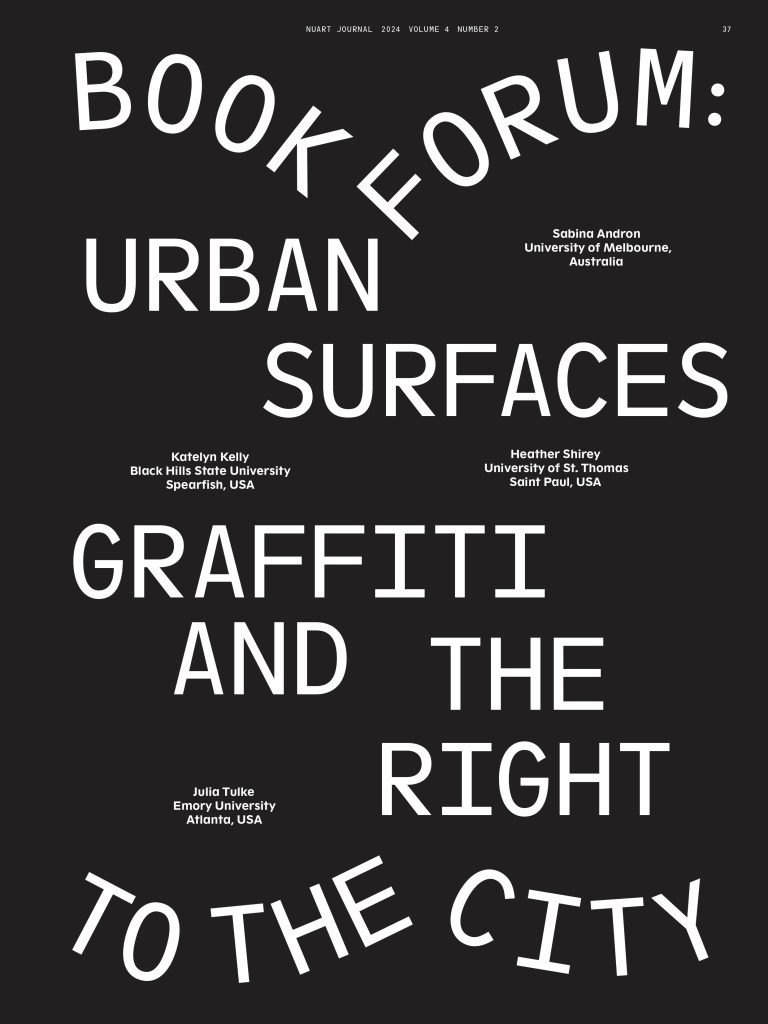
Book forum: Urban Surfaces, Graffiti, and the Right to the City
A discussion with Julia Tulke, Hearther Shirey and Katelyn Kelly about my book in Nuart Journal 🔥
Andron, S., Kelly, K., Shirey, H., Tulke, J. (2024). ‘Book forum: Urban surfaces, graffiti, and the right to the city’. Nuart Journal Vol 4 (2)
London Launch January 2024
With Rebecca Ross, Rafael Schacter, Enrico Bonadio, and Susan Hansen. Hosted by Iain Borden at the Bartlett School of Architecture.


Melbourne launch April 2024
With Chris Parkinson, Megan Hicks, and Lachlan MacDowall. Hosted by Bookshop by Uro at Collingwood Yards with support from the Melbourne Centre for Cities.


The book is available to purchase from Amazon and Taylor & Francis.
 SABINA ANDRON