
This response was submitted to the City of Melbourne on 1 November 2026. Consultation on this policy is open until 5 November 2026 and a submission can be made here.
The text below is an extended version of an op-ed I published on 30 October: “Melbourne loves graffiti. So why is it spending millions to remove it?”.
You can also listen to my ABC Radio Victorian Evenings conversation with David Astle from 1:14:50.
A pdf version of the response can be viewed and downloaded below.
Preliminary comments
Thank you to the City of Melbourne team for all the work they put into developing this new Graffiti Management Policy, which amplifies and focuses the extensive experience of this team and their thoughtful approach to the visual culture of our city. As much as this policy stems from this experience, it also upholds a politicised view on graffiti which in my opinion fails to do justice to Melbourne’s relationship with this culture and consumes municipal resources at an unprecedented scale.
I write this as an Australian Research Council-funded urban scholar who has researched graffiti for more than 15 years across several countries and has published extensively on the topic.
I start this submission with a quote from the City of Melbourne’s first Graffiti Management Plan, which dates back to 2005: “This Graffiti Management Plan demonstrates Council’s get tough on graffiti approach. The Plan aims to generate lasting change in attitudes and behaviour towards graffiti. It clearly states that graffiti is not acceptable in the municipality and the City of Melbourne will do everything in its power to eradicate this vandalism.”
I want to point out three aspects here:
Firstly, Council should be commended on coming such a long way from the zero-tolerance language that underpinned its first formal response to graffiti. This is the merit of Melbourne’s incredible graffiti community who has created and advocated and pushed the discourse on the culture; but also of increasingly progressive Council officers who see the value of the culture and understand the fine and difficult balancing act of mediating the needs and desires of a huge number of stakeholders.
Secondly – Council is right. They do have the power to “generate lasting change in attitudes and behaviour towards graffiti” – and this is where the good work can start. As many scholars from around the world have pointed out for decades, we have systematically developed a “‘graffiti problem’ problem”. This is not a material issue of graffiti itself, but a discursive one, in which publics must be educated to believe that graffiti is a problem to begin with. Karen Crawley’s paper, “Beyond the war on graffiti: the right to visual expression in urban spaces”, published in 2015 in the Griffith Journal of Law & Human Dignity, is an excellent local example of this symptom.
And finally – graffiti is acceptable if we decide to accept it; and acceptance might be the smartest and most powerful policy move that can be made.
Overall comments on the new policy
The Graffiti Management Policy 2026 is intended to supersede the existing 2021 Graffiti Management Framework. It also includes and formalises measures that have been put in place and endorsed since 2021, such as the Enhanced Graffiti Prevention Management Plan (2022), proactive removal strategies, and the ‘You spray, you pay’ policy of 2025.
Major changes include a change in the definition of graffiti and street art; an increase in the operational control and ambitions of council; a strengthening of enforcement strategies; enhanced considerations of environmental sustainability; and an inclusion of recognised open painting locations.
The new policy proposal is much more extensive than its previous iteration. This is evidence of a maturing team, leadership, and sets of practices; but also points to increased investment, oversight, and prescription of graffiti “prevention, reporting, and removal”.
A “clean, safe and welcoming” environment is the main statement of value and principle in the proposal; and there is no reference to the political, culturally complex and contentious nature of graffiti, or its role in constituting urban publics and civic discourse, and in supplying a pipeline of talent for the “legal street art” and “commissioned murals” which council explicitly supports in this policy.
The policy is presented as a “data-driven” approach to graffiti management, which includes “historical graffiti trends, volumes, hotspot analysis, community impact and strategic importance of locations”. There is little evidence of divergent perspectives being accounted for; or of the principles by which graffiti is considered undesirable and to whom.
Overall, this management strategy is more operationalised and positivist data-driven, with stronger enforcement and asset owner obligations, and an increased level of Council authority.
1. Definitions
The 2026 Policy draft defines graffiti as unauthorised marking (including non-aerosol media such as posters and stickers). Authorisation here refers to both the consent of the property or asset owner; and to any relevant heritage approvals and planning permits. Authorisation is therefore a matter of compliance with council policy as much as the protection of private property as per the Graffiti Prevention Act 2007.
Definitions also include those of street art and commissioned murals (the latter a new addition to the new framework). The major difference is that the previous framework did not place the lack of authorisation at the centre of the definition of graffiti. In other words, the category of “legal graffiti” has been superseded, which creates a greater division between graffiti and street art and fails to recognise they belong to overlapping communities of practice and urban visual cultures. The further separation is not true to the culture and in my opinion it only serves political purposes by making it more convenient for Council to “celebrate” street art while hardening its stance on graffiti.
2. Responsibilities
More granular definitions of private asset holders are offered and the Schedule A document clarifies their jurisdictions.
Council is much more specific about who it regards at stakeholders in graffiti management. It also gives them responsibilities: property owners and occupiers, developers and permit holders, artists, and community members are all expected to follow Council’s leadership in managing graffiti.
Owners, developers, and other asset holders must meet Council service levels, with possible referral into “Unsightly Premises” compliance processes if they do not. This gives Council a stronger role in establishing an expected condition for private surfaces and visual amenity; and increases the burden of uniformity in making choices about visual presentation and diversity. It also places a huge duty on asset holders.
The expectation that managing bodies of building sites, private assets, or construction hoardings remove graffiti from their assets in a timely and focused manner is burdensome and heavy handed. Has this been negotiated with these stakeholders? What were the terms of that negotiation?
Construction hoardings are a particularly important example. Developers are expected to achieve the same level of graffiti removal service, including one hour removal for offensive graffiti. The labour and resourcing implications of this should be more carefully considered. Hoardings could be given granularity as a unique type of temporary surface where graffiti can be practiced safely without damage to property and with a high rate of visual turnover. At the very least, removing graffiti from hoardings should not be an obligation. Developers could be encouraged and supported to include artwork on their hoardings (which has been trialled with the Creative Hoardings program); and should be given a possibility to opt out of removing graffiti.
3. Service standards
This new section signals an overall shift to a standardised service policy that is almost entirely focused on service delivery. This is expressed in the following:
- Precise timelines for removal: one hour for offensive graffiti; Central City 3 days; Outside City 12 days; complex works 90 days.
- 24/7, 365-day operational commitment. This is not comparable to any other Council service such as street cleaning, rubbish, public toilets, parking or any other local law enforcement. Here I want to pause and raise the following question: why does graffiti take such high precedence among Council services and is it truly proportionate with a practice of surface mark-making?
Another innovation of the policy is the opt-out model. This means that graffiti on private property may be removed unless the owner actively opts out, so council has access to private surfaces without the need for notice or written consent. Moreover, owners who opt out are expected to maintain the same level of service themselves.
The opt-out model is not common in any comparable cities. New York City’s 311 system offers free removal from private property with 35 days notice, and an opt IN service with a “Forever graffiti free” form. Following the issue of a notice, if the owner doesn’t respond, the graffiti is removed after 50 days. Greater London has a similar notice-based system in most boroughs, which assumes the first authority over a surface lies with the property owner. The opt-out model in Melbourne positions all owners as taking an anti-graffiti stance although that might not be the case. It is a good example of Council exercising power, which begs the question of whether that power could be used in support of creative communities and their dialogues with various stakeholders.
A note here on the Graffiti Prevention Act 2007 and the opt-out model. Under the GPA2007 Section 18, Council “may” take action against graffiti on private property – ie Council is authorised but not obliged to remove graffiti from private property. It does not have a duty to remove graffiti from private property – so the opt out model is not prescribed by the GPA2007; and it in fact appears to be at odds with it – see Section 18.3, which states that “Council must serve a notice under this section on the owner or occupier of the property at least 10 days before the action to remove or obliterate the graffiti is proposed to be taken”; and opt-in only subsequently applies within 12 months of such authorisation being granted.
Definitions of offensive graffiti introduced in the new policy are welcome and so are the mentions of environmental sustainability; but more details are needed on quantities and specifications of chemicals used for graffiti removal, and a framework for balancing visual harm (which is an underlying assumption of graffiti) with environmental harm caused by chemicals.
4. Enforcement
I am raising concerns about Council’s positioning as a police informant and assistant prosecutor.
Collaboration with Victoria Police is explicitly written into the policy through “supporting the investigation and prosecution of graffiti offences”. Council should not become a police informant. The consequences of this approach have been flagged for decades by leading graffiti researchers here in Melbourne – and I quote here colleagues Alison Young and Mark Halsey who were warning in 2002 that “success stories of punitive council projects only bring more people into the criminal justice system” (Halsey and Young 2002: 179).
Furthermore, Council should not become an assistant prosecutor either. The promise in Section 1.6.b concerning “Preparing and submitting Victim Impact Statements, where appropriate, to assist courts in understanding the financial, operational and community impacts of graffiti offences” is an inappropriate use of resources. City of Melbourne staff should not be paid to help prosecute those who are already impoverished. It should instead invest in safeguarding the visual expression and creative development of a community that has contributed more to Melbourne’s beloved urban atmosphere and character than many others have.
Finally, “You spray, you pay” turns graffiti removal into an economic model where it is no longer simply an amenity service, but also connected to recovering costs and financial accountability.
This echoes Council’s recently adopted “You break it, you buy it” policy for defacing statues and monuments, and prompts the question of why particular forms of visual and property damage are being singled out for an explicit cost recovery model, while other offences like illegal dumping are not, although they also impose a direct cost on Council.
Offenders’ expected accountability must be matched by removal contractors through transparency about how removal costs are calculated. Describing repeated environmentally harmful operations in terms like removing “five MCGs worth of graffiti” will no longer suffice.
5. Legal street art
“Legal graffiti” is no longer a category in this draft.
Street art is more formally recognised than in the 2021 framework. It is acknowledged to have no guaranteed longevity and to develop organically. However, this terminology only applies in what are recognised “street art precincts” (see Schedule B: Hosier Lane, Flinders Court, (From Council Lane CL0496 to Flinders Lane), Croft Alley, Dean Alley, AC/DC Lane, Duckboard Place, Stevenson Lane, and the Avenue Underpass – Parkville – Capital City Trail), with surfaces outside these lists being “graffiti hotspots”.
The difference between a “street art precinct” and a “graffiti hotspot” is not aesthetic. Many of them look exactly the same. What are the considerations used by Council in creating these distinctions?
According to Section 1.8, “Artists are required to gain written approval from the property owner, and contact City of Melbourne to ensure the proposed artwork complies with all relevant planning, heritage and local law requirements including images of the proposed design and location.” Therefore painting can only take place “organically” within designated locations. This is very hard to enforce and does not accept the unregulated, unplanned, and less prescriptive nature of wall writing cultures.
A small note here on the lack of clarity between the street art precincts in Schedule B and the statement that “Hosier Lane is the only recognised ‘free to paint’ area within the City of Melbourne.” Council should clarify.
What is missing
Contractors: There should be a detailed section on the contracting process and the expectations Council has of its graffiti removal contractors.
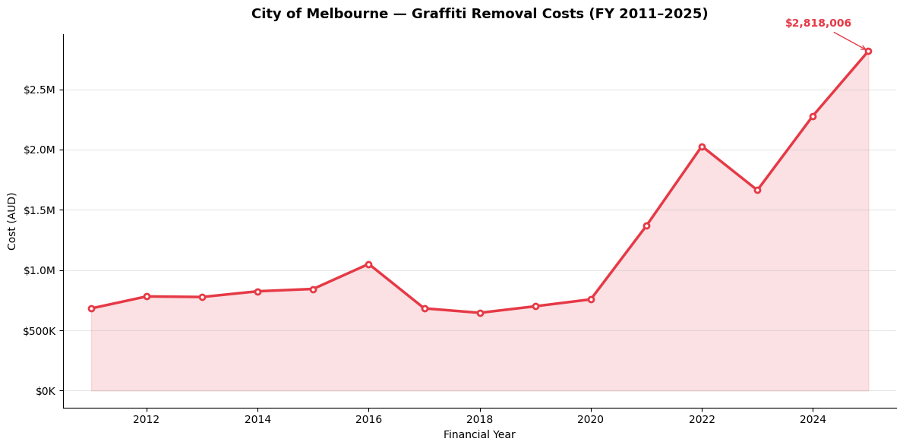
Budget: at the moment, all the numbers are going up: we have more graffiti being reported and removed; more graffiti being created; and more money spent every year on its management. How is it possible that all the numbers are going up, yet there is no tangible community benefit?
Four data points go into the financial calculations of graffiti removal: dollar cost, surface area cleaned, instances of graffiti removed, and number of public reports of graffiti. We know from extant literature that this type of data is inconsistent and unreliable – for example, what is an “instance” of graffiti and how is it calculated differently from a square meter? Qualitative clarification of this data is vital to understanding how removal economies are generated and how the expenditure can not only be reduced, but also targeted more equitably, beyond the unattainable eradication of graffiti. Council must provide a clearer understanding of how these numbers are calculated, and how they lead to community outcomes.
See below City of Melbourne graffiti removal costs since 2011, as per a Freedom of Information request. All numbers are per financial year.
Prevention and engagement strategies: Council should clarify what these entail with the same level of granularity it affords to its service standards for removal. Currently, the only mention is in Prevention 1.1.6. “City of Melbourne supports community and youth education initiatives that promote legal artistic expression and raise awareness of the social and economic impacts of illegal graffiti”
Recommendations
Use a spatially-driven approach with tacit no buff areas and an abundance of legal walls for experimentation. Make it easy and accessible for people to have spaces to develop their practice. More time to paint = better works for everybody and less reason to tag. Construction hoardings could become spaces for temporary visual production rather than surfaces subject to the same removal expectations as buildings and other fixed assets.
Bring graffiti writers into the policy process and afford them the same respect and granularity of engagement as other stakeholders described in the Draft Policy.
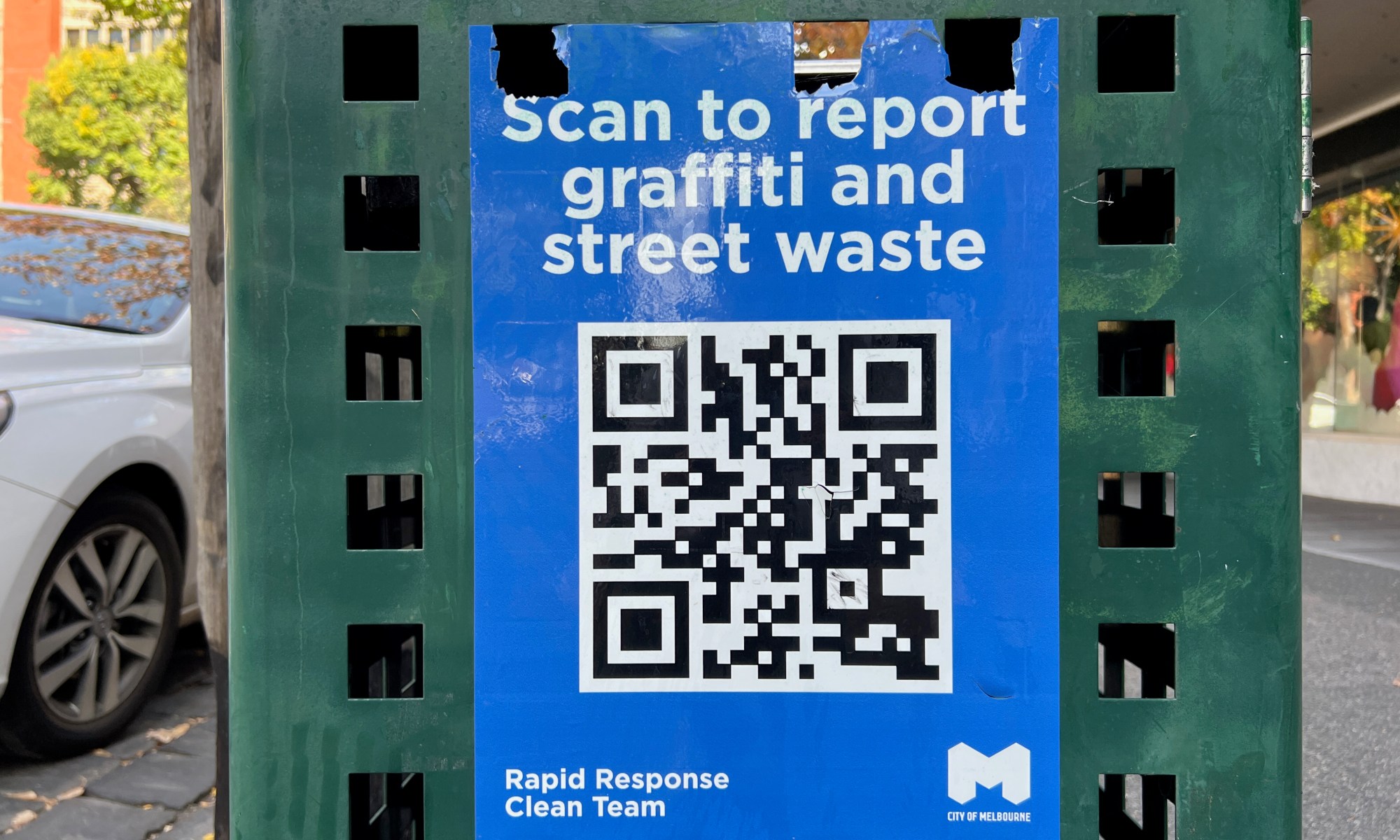
Make community engagement about more than reporting through QR codes on bins. Consultation mechanisms should also capture positive, ambivalent, and conflicting responses to public images, including the cultural value residents attach to graffiti and street art. Council should facilitate conversations about graffiti in appropriate forums between artists and community members who are most affected by it.
Put environmental care over visual policing by measuring and publicly communicating the environmental costs of repeated graffiti removal, including through the use of chemicals, water, and paint. Environmental impact should be part of decisions about when removal is conducted.
Lower removal budgets now! and shift investment towards robust diversion, development, and creative programmes.
The City of Melbourne has the scope to become an international leader in public policy informed by visual justice and driven by values, not just data. I welcome the opportunity to make this submission and I look forward to continued engagement with Council on this and other matters.

